Showing posts with label UChicago. Show all posts

Sunday, January 15, 2012

An Uncommon College Experience

Recent post comments have asked me to post about my experience as a first-year at the University of Chicago. Having completed my first quarter, I think IҀm finally prepared to share that. IҀm now stocked with my own photos of campus and personal exposure to the university that just months ago existed to me mostly on paper.


To give you a general outline of my life at UChicago, IҀm a first-year living in Dodd-Mead House in Burton-Judson Courts. IҀm currently taking required Humanities and Social Science Core sequences, as well as Latin and humanities electives. Outside of the classroom, IҀm in several reading groups and academic clubs, a writer for The Chicago Maroon and College website, and an after-school philosophy coach for neighborhood students through the Civic Knowledge Project.

After visiting campus many times my senior year for various campus events, my residential experience here officially began in late September with Orientation Week, known here as ӀO-week.Ԁ First-year students move into their houses one week before classes begin and have a chance to get to know their fellow classmates and the University more broadly. ItҀs an unusually social time for students here, many of whom donҀt typically come out of their shells or have Ӏfamily timeԀ with their housemates. With O-week began my praise of the (Harry-Potter-style) House system, which provides a great group of friends with which to attend campus events, explore Chicago, and generally relax with outside of class.


Student life at UChicago is constantly buzzing with various activities, both on and off campus. These are the perfect compliment to academic life. In just this past week, IҀve attended two career events; four club meetings; three public lectures on topics ranging from economics to religion; attended a school-sponsored Lascivious Ball (IҀll let the name speak for itself); and taken advantage of Chicago by exploring Chinatown with my house and seeing the Chicago Symphony Orchestra, Lyric Opera of Chicago, and Art Institute of Chicago. I also have to plug queer life here, which is very well established on campus and, like everything at UChicago, has a definite intellectual slant that refreshingly defies many queer stereotypes. Generally, student life here has a lot to offer if one is proactive and takes advantage of it. ItҀs often tough to balance everything, but I love penciling exciting new events into my calendar each week.

Though extra-curricular life has certainly been eye-opening, the deeper transformation occurred in my classes this past quarter, which were unlike any I had taken before. The Humanities and Social Science Core have truly changed the way I think and write after just one quarter. Both of these sequences examine great books without the ӀslantԀ with which traditional classes approach a work. As a quote engraved in Harper Memorial Library summarizes the College's Great Books approach: ӀRead not to believe or contradict, but to weigh and consider.Ԁ


The closest thing to the Core I have taken before are two Freshman Seminars at Harvard, which it turns out have little in common with my current classes. Freshman Seminars at Harvard (and most other colleges, from my understanding) approached a specific topic with a faculty expert and focused almost exclusively on the course material. Core classes are nearly the opposite; the texts we read are springboards into more universal topics. Discussions regularly descend into fundamental philosophical debates to the likes of Plato and Aristotle in RaphaelҀs The School of Athens.

In accordance with the Socratic method, Core class discussions arenҀt guided to a specific destination, but that doesnҀt make them flimsy. Comments are expected to be relevant, insightful, and almost always to reference a specific passage in the text. This classroom method of claims, evidence, warrants, and counter-claims is meant to work hand-in-hand with the expectations for academic writing at Chicago, which are emphasized from the very beginning in an additional peer writing seminar which students must pass as part of their Humanities Core. The seminars themselves get mixed reviews from students, but the general theme is central to the CollegeҀs academic mission: critical inquiry and precise means of argument are the backbone to any liberal arts education. Professor Wendy Doniger described that philosophy most aptly in an anecdote she read for Convocation one year:
Once when I returned to Hyde Park after a long trip abroad, I dashed off to the Co- op, of blessed memory, to restock the larder. As I waited to check out, I overheard the conversation of two undergraduates standing in line in front of me. ӀNo,Ԁ said one to the other, Ӏbut thatҀs not what Aristotle meant by that.Ԁ ӀAh,Ԁ I thought with a happy sigh, ӀIҀm home.Ԁ It was not merely the subject of their debate׀Aristotle, the poster boy of the Common Core׀that identified them as my people, but the style in which they were debating, the contentiousness of their discourse. That intellectual style is one of the things for which the University of Chicago is justly famous, our cultivation of the hawk eye that pounces on the unexamined assumption, the false logical link, the shoddy piece of evidence. And we are right to be proud of that training.
׀Wendy Doniger, Mircea Eliade Distinguished Service Professor of the History of Religions at the University of Chicago Divinity School, June 2008 Convocation Speech entitled ӀThinking More Critically About Thinking Too CriticallyԀ

In writing this post, I re-read my review of UChicago from my first visit in 2009. My understanding of the University has changed greatly since then, to say the least. For one, I was then a believer in the self-deprecating slogan, ӀThe University of Chicago: Where fun comes to die.Ԁ I saw Chicago then as extremely niche and a college experience defined by the sacrifice of social life and non-academic activities. (Never mind that my house currently sells mugs bearing a picture of Cobb gate with the inscription "Abandon all hope... Ye who enter here," playing on the O-week photo above.) Though these characterizations arenҀt "wrong," theyҀre fundamentally misguided in that they attempt to squeeze Chicago into a narrow box. On the contrary, ChicagoҀs best attribute is its resistance to such oversimplifications via its emphasis on free speech and its diverse modes of inquiry. A perfect example of this is the "Aims of Education" speech delivered to my Class of 2015 during O-week. The speech was from a statistician who presented real-world data in the form of charts and graphs with little interpretation, thus deliberately leaving it up to us to determine how it related to education in our small discussion groups following the talk.


A summer job application recently asked me to share Ӏwhat I considered my greatest achievement and why.Ԁ I thought really seriously about this question for days. In the end, I felt that listing an accomplishment or award from high school would really just be resting on my laurels, which is something I try to avoid on principle. It occurred to me then that my greatest accomplishment in life thus far is that I ultimately chose the University of Chicago for my college experience. I have never been more proud of a decision in my life. Having visited over twenty top colleges, many of which provide a significantly "happier" college experience, I've had my share of reservations and doubts. (To the like of Barry Schwartz's The Paradox of Choice, be warned that the more colleges you visit, the more objects you will have for comparison. You thus run the risk of being less satisfied with the one you finally choose!) Yet, my doubts have fully dissipated, and, as it turned out, I knew what I wanted from the very beginning, when I first visited UChicago in summer 2009.

I chose the most challenging institution I came across from the over two-dozen that I visited. The one thatրfrom day oneրfanned my sense of curiosity, made me question and defend my ideas, and promised no Ӏeasy way out.Ԁ The University of Chicago's mottoրCrescat scientia; vita excolatur, or Let knowledge grow from more to more; and so be human life enrichedրmeans more to me than ever before. Being a part of what has been called "The Great American University" has taken my life, not just my education, that much closer to where I want it to be. As my professors and peers here have shown me in equal part, that symbiotic journey of intellectual and personal discovery, however grueling, is one worth embarking on.

Sunday, January 2, 2011

The Choice Has Been Made

After years of visiting dozens of colleges, sitting through far too many standardized tests, worrying about report cards, spending countless nights exploring reviews on Unigo.com in the wee hours of the morning, and boring my friends and family with long-winded rants about which college may be right for me, I have finally chosen a college. After a great deal of deliberation over my winter break, I sent my deposit to the University of Chicago on December 31st, just in time to have an anxiety-free 2011 with no more waiting.


As an accepted student in (likely) the most competitive class year to date, I am feeding what one education blog calls Chicago's "institutional ego" to become more on par with schools like Harvard or Stanford as far as prestige is concerned. Following up from my most recent post on application inflation, Chicago is the school most in the spotlight right now because it is moving up the prestige ranks (ironically determined by rejection rate) at an alarming pace. To put the school's growing competitiveness in perspective, a Chicago Maroon article detailing last year's admission season noted the fact that in 1993, the year of my birth, Chicago's acceptance rate was 77%. That means that during my short lifetime, this institution has become more than four times more selective. Harvard, by comparison has become roughly twice as selective in this same time period.

Is this the reason I chose Chicago? No. But this news is strongly correlated with what did draw me to the school as perhaps its greatest resource: a brilliant, engaging undergraduate population that I know will challenge me to become all that I can be.

The question then arises: how did I know that I would fit in with Chicagoans? A few reasons:

1. They accepted me. As strange as it may sound, I have long been prepared for rejection from this unique intellectual community. If I wasn't meant to be part of it, I would not have received an offer of acceptance, and I would have found my place elsewhere. The institution wanting me made me want it.

2. I had a fantastic time on my overnight visit. I discovered that life at Chicago had the social-academic balance I wanted in my college experience. This was made clearest by the house system (like that in Harry Potter) enhancing the academic experience I got from classroom visits.

3. The Facebook group for class of 2015 admitted students has been an extremely compelling advocate for my choice. I have, in two short weeks of this community existing, met several people I would consider true friends. Discussion questions on the forum such as "what is your favorite fruit?" turned quickly from taste to world history to literary devices and ended in foreign languages. I love the intellectual energy so apparent in what would be my future classmates. (Interestingly, it has also been noted that as the entering class becomes more selective from year to year, the Facebook group discussions have become more lively.)

4. Compared to the small liberal arts colleges I have been considering alongside Chicago, notably Swarthmore, I felt that Chicago could encompass the small school feel if I wanted it via the house system breaking up the undergraduate population into small families of around 40-100 students. Meanwhile, Chicago's unique position as a research institution (8th in the world) coupled with the "best undergraduate academic experience" in the nation (Princeton Review, 2007) provides me with the community feeling I want with room built in for the spontaneity that defines the college experience.

5. I just felt that it was right for me, and that I wouldn't regret the choice. It's obviously not a perfect institution, but it was one where I felt that I could work around the schools weaknesses.


Thank you for all of your support along my personal journey towards both finding the college right for me and being admitted to it. I can't tell you how many complimentary emails and comments from bloggers have made my day. On the sculpture picture below (Cobb gate), I have made it passed the admissions committee (the dragon gargoyle at the base) and am officially a puny first year, bound to metaphorically struggle up the slope until I have completed my fourth year, at which time I will apparently sprout wings and proudly fly out into the real world.


But it's not time for goodbye, and my work here isn't over yet. In the coming months, I plan on exploring and perfecting my own study habits in preparation for my college experience, inspired by what productivity genius Cal Newport has done on his own blog, Study Hacks.

Now, please excuse me while I dump out three file cabinets of college view-books and donate my Princeton Review books to the next generation of college searching students.

Tuesday, June 22, 2010

University of Chicago Essay Questions released for 2010-11

As you can see from many previous postings on the school, the University of Chicago has always been one of my top choices, and I couldn't agree more with the school's ancient academic philosophy. Recent additions to social improvements and amenities on all levels of the university, from re-introducing a football team (they used to be a member of the Big Ten!) to implementing the house system of living for undergraduates, have made that age old, gold standard, academic intensity more accessible and enjoyable for enrolling students. If you've not looked into the school, I would highly recommend it for those who prioritize "the life of the mind" (as the college's saying goes).


Chicago has long been defined by its quirky, intellectual essay questions, mentioned in a few previous posts. If you want to get a head start on Chicago's application for the 2010-11 application, the just released essay questions are as follows:

Essay Option 1: Find x.
Inspired by Benjamin Nuzzo, an admitted student from Eton College, UK

Essay Option 2: Dog and Cat. Coffee and Tea. Great Gatsby and Catcher in the Rye. Everyone knows there are two types of people in the world. What are they?
Inspired by an alumna of the Class of 2006

Essay Option 3: Salt, governments, beliefs, and celebrity couples are a few examples of things that can be dissolved. YouҀve just been granted the power to dissolve anything: physical, metaphorical, abstract, concreteŀ you name it. What do you dissolve, and what solvent do you use?
Inspired by Greg Gabrellas, A.B. 2009

Essay Option 4: ӀHonesty is the best policy, but honesty wonҀt get your friend free birthday cake at the diner.Ԁ - Overheard in the city of Chicago.
Does society require constant honesty? Why is it (or why is it not) problematic to shift the truth in oneҀs favor, even if the lie is seemingly harmless to others? If we can be Ӏconveniently honest,Ԁ what other virtues might we take more lightly?
Inspired by Eleanor Easton, a second-year in the College

Sunday, March 14, 2010

Insight into the Admissions office of UChicago

The following article is quite dated (from a 1999 Newsweek issue), but quite telling as for the kind of thinking that admissions officers are forced to utilize when forced to meet so many quotas. What may seem to be a negligible distinction between two applicants often makes the cut, and the article lists a few great examples that most people wouldn't have caught on to.

I mentioned quotas before, and I think the U of C approach to them is interesting.

"Their ethnicity, something that many applicants don't divulge, still isn't known in the aggregate. Chicago prides itself on using no gender, racial, geographic or other quotas in deciding whom to accept. "We're not 'building a class,' creating this ideal little world with so many of these and so many of those," O'Neill says. "We accept the best, and hope to get as many as we can."

This is a constant struggle for me when I am looking into campus demographics; trying to objectively interpret a campus culture from mere statistics or snippets of student input. What I have found true for most schools is certainly not consistent with Chicago's statement above; most top colleges are indeed statistically (racially) diverse, but are still overly homogeneous in opinion and politics.

This statement is surely taken into account by people viewing "diversity" statistics, but I don't think most people account for how true this problem really is on college campuses. The product of this thinking is generally an unbalanced and overly liberal student body which, though open to new ideas, is intrinsically closed to much of America's real political sentiment, inadvertently hampering campus "diversity".

The article is linked here: University of Chicago Admissions - Newsweek

Tuesday, December 29, 2009

The University of Chicago

Chicago, Illinois
August 9, 2009

I donҀt even know where to begin the account of my experience with UChicago. Just the name gives me goosebumps. Growing up in a suburb of the city itself, it has long been a college on my mind, and is a relatively popular choice at my school, due to its notable prestige and academic prowess. Of course, plenty of people, even in the Chicago area, donҀt understand how important the school really is, often mistaking it for the University of Illinois at Chicago and not realizing that the 7th best university in the world (QS 2009) is in their backyard. Even more dangerously, many of my fellow prospective students donҀt realize how unique Chicago is. They donҀt know enough to understand that Chicago caters to a relatively small, specific demographic of students: those willing to sacrifice a raging social life, extra-curriculars, and their sanity, all for a nearly unmatched academic atmosphere and all around collegiate education.


LetҀs begin with just that: the education. The main components of ChicagoҀs curriculum can be broken down into three sections, each consuming about one third of a studentҀs time at Chicago; Core classes, or required classes of all undergraduates, major requirements, or classes required for each departmentҀs major, and elective classes, or free choice classes to round out the experience. This is an alarming level of requirements for a modern college curriculum. There are few other top colleges with such extensive core-curriculums, much less ones so rigorous. Courses required of all undergraduates range from exposure to great books and philosophy to more general math and science reasoning courses. Because of these demanding requirements, it is a long hike to earn a Chicago degree. It is a truly stimulating amount of work, and one has to make a lot of personal sacrifices to complete it. However, Chicago is one of the leading schools in terms of sending grads on to get PhDҀs as well as other professional degrees. Employers and graduate schools know how demanding the academics at Chicago are, and they look highly upon how well the school prepares its students for academic life.

ChicagoҀs campus is equally amazing. Located about twenty minutes (by subway, bus, or car) south of downtown Chicago. Though the immediate area surrounding the universityҀs neighborhood of Hyde Park is quiet and upper class, as little as a few blocks off the campus can put you right in the middle of some of ChicagoҀs worst south side neighborhoods. The school takes advantage of its location, offering field studies in Chicago and urban studies to study these surrounding areas. Due to the campusҀs location, crime is fairly high, and students are always on the lookout. This is a downside to any city campus though, and should be taken with a grain of salt; the immediate area surrounding the university is well policed (by the largest private police force in the country) and well lit, so as to provide a bubble of relative safety around the campus.


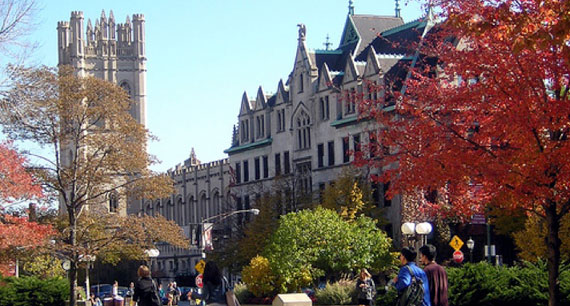
Chicago is a city I think everybody should see sometime in their lifetime, and the university only adds to the cityҀs magnificence; UChicago has a jaw-dropping campus. The reason it is so beautiful and symmetrical is because it was built from the ground up from RockefellerҀs fortune, so the school was planned from its first days as a university, unlike most college campuses, which are architecturally eclectic because they were built over time and on budgets. It simply looks like a place to learn. The campus is still mostly composed of the original collegiate-gothic buildings, but plenty of interesting, modern, buildings add to the scene. When I first visited the campus, I couldnҀt help but to just lie down for a few minutes in a quad and stare at the hundred year old oaks and the ivy on the buildings rippling in the wind.

Among these buildings, the Regenstein Library, also known as simply Ӏthe RegԀ, seems to be a campus favorite. This building has seven full sized floors of material, and the university is expanding the library this summer with a state-of-the-art underground book retrieval system to house even more books. There are plenty of rumors surrounding this building, but nearly all have to do with students Ӏnever leavingԀ to fulfill their tremendous workloads. The Reg is an amazing facility which I really enjoyed my time in, and it provides a great atmosphere for Chicago students to work in, in addition to the many great coffee shops on campus.


Essentially, the best way to wrap your mind around Chicago is that it is a uniquely academic place and that a school canҀt have everything. The university has accordingly been nicknamed the place Ӏwhere fun comes to dieԀ due to its weak social scene and high workload. Though the school is making great steps towards introducing a more vibrant social scene to the campus, it seems almost counter-intuitive to add this element to only increasingly rigorous academics. One of these elements that seems extremely popular is the House system of first year housing. Students are assigned to a social house (think Harry Potter), which becomes their family for the next four years. Students eat meals at their house table, and even after upperclassmen move off campus, many still attend social house events.

However extreme the school might seem, keep in mind that the Princeton Review dubbed Chicago Ӏschool of the yearԀ in 2007 for overall undergraduate experience. I see that ranking more political in purpose than genuine (the Princeton Review has for quite some time been labeled as too focused on social aspects of institutions), but the point still stands that this is truly a great place to spend your four years. As long as you have done the research and have truly established academics as your number one priority, Chicago could very well be the place for you. This sort of self-selectivity where students are ӀafraidԀ of the school has kept the schoolҀs admissions numbers relatively lenient compared to itҀs Ivy League competitors. However, Chicago saw a 100% increase in Early Action applications for the 2009-2010 admissions season, so the school may well be on the track to catching (back) up to the biggest names out there.